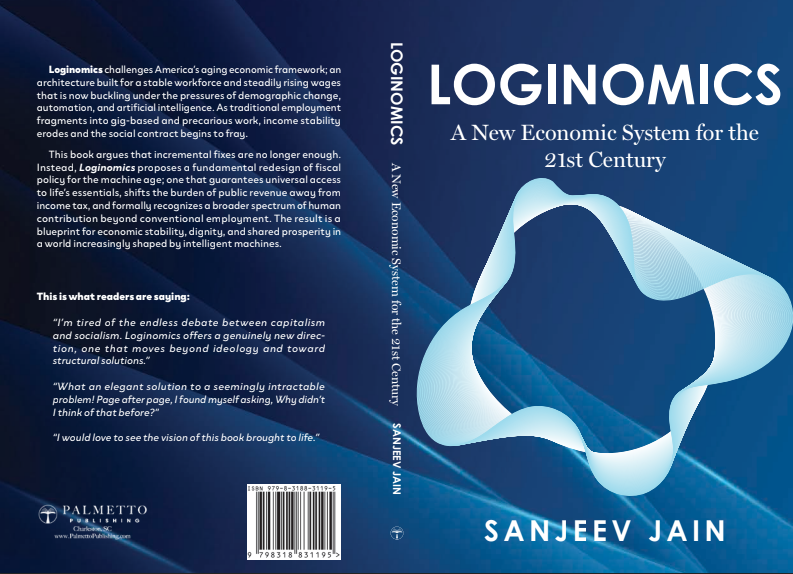
The Economy Was Never Built for This
The economy your grandparents relied on is quietly breaking down. Automation is speeding up the collapse. Stable careers are dissolving into gig work. Healthcare costs keep climbing. Wages are still stagnant. You know about the reports and watched the debates. You tried to make sense of the fixes. But they still feel inadequate. Incremental. Almost insulting.
It’s not your imagination.
America’s economic framework was for a world of steady employment and rising wages. That world no longer exists. No amount of tweaking tax brackets or adjusting interest rates will fix a structure never built for intelligent machines. The system was not designed for aging populations. It was also not for a workforce that can’t rely on a 9-to-5 to survive. The problem isn’t political. It’s architectural. And you already know it. Loginomics builds the blueprint for what comes next.
Loginomics Doesn't Just Diagnose the Problem. It Builds the Blueprint.
Sanjeev Jain holds dual doctorates in biochemistry and medicine and practices as a physician specializing in allergy and immunology. Known for his analytical depth and inventive approach to problem-solving, he has consistently bridged scientific rigor with real-world innovation. As an allergy specialist, Jain developed novel treatment protocols for food and environmental allergies and co-authored a book on food allergy therapy. During the COVID-19 shutdown, he identified three foundational challenges confronting humanity, which led to his co-authorship of Logiverse: A New Paradigm for a Grand Unified Theory and to the sole authorship of Loginomics. He is currently working on Loginance: A New Form of Governance for the 21st Century.
It isn’t another book that tells you what’s broken and leaves you there. Loginomics gives you a clear, research-grounded framework for how a modern economy should work. It should be around one built around human capacity, not employment status.
This study uses real life examples like housing and health. It makes difficult economic theories feel relatable. The study also provides a set of terms and a clear structure you can use for your own research or when talking to policymakers.
Here’s what you’ll walk away with:
The Crises You See Are Not Accidents
A clear understanding of why today's economic crises exist. You will know that housing and income instability are not accidents. They are logical outcomes of a system that has artificial scarcity. A new way to think about sovereign money and public revenue that is more than the household budgeting analogies.
A Framework You Can Use
Three foundational commitments for a post-employment economy: guaranteed access to essentials, a restructured tax system, and formal recognition of creative, athletic, and scholarly contributions as real economic value.
The Ideas Inside This Book Will Change How You Think
Every concept in Loginomics can be understood and applied. They are something built upon. Be it fiscal policy or post-employment society.
Understand why economic crises are structural, not accidental
See beyond household budgeting analogies politicians always use
Learn how sovereign money works in practice
Discover why housing and healthcare failures were predictable
Get three clear commitments for a post-employment economy
Understand how to restructure revenue away from income tax
Recognize creative and scholarly work as real economic value
Apply the framework directly in research and policy conversations
Use real case studies to ground abstract economic theory
Build vocabulary that maps to the world we actually live in
THE THREE PILLARS OF LOGINOMICS
A Fresh Approach for the Modern Era
Loginomics has three core commitments. Each replaces outdated assumptions with principles that match the world we live in today.
Guaranteed Access to Essentials
Every person deserves access to important needs. No matter what their employment status or income level is.
A Restructured Revenue System
Eliminate income tax. Tax rents and system usage instead. Align public revenue with how modern economies generate wealth.
Recognition of Human Contribution
Creative, athletic, and scholarly work has real economic value. The 21st century economy must acknowledge that truth.
How to Build an Economy for People, Not Just Machines
Preface: An Economy Designed for Humans in the Age of Automation
Chapter 1: America’s Fiscal Model Was Built for a Different Century
Chapter 2: Why the Old Toolkit Fails
Chapter 3: Technology Has Upended the Job Market Before. But This Time Is Different
Chapter 4: The Illusion of Government Finance
Chapter 5: What Money Actually Is
Chapter 6: The Federal Reserve and the Plumbing of Money
Chapter 7: Government Spending and Money Creation
Chapter 8: The Mission of the Federal Reserve Under Loginomics
Chapter 9: The Dollar Cycle and the 15 Percent Rule
Chapter 10: Dual Treasury Accounts—Essentials and Discretionary Spending
We’d love to hear from you, whether you’re a reader with a burning question or a policymaker interested in the Loginomics framework. We are seeking to turn these abstract economic theories into real-world solutions. Your feedback is a vital part of that mission. Reach out to discuss the book and inquire about speaking engagements. Share how these ideas resonate with your own experience.
Email Address
sjain@oridigm.org
Location Address
Oridigm Inc 43575 Mission Blvd #716 Fremont, CA 94539 USA