
Loginomics
A Practical Blueprint to Redesign a Broken Economy
Explains why automation is dismantling traditional employment permanently
Reveals how artificial scarcity drives housing and healthcare crises
Challenges the household budgeting myth behind fiscal policy
Introduces sovereign money as a tool for real reform
Proposes eliminating income tax in favor of smarter alternatives
Outlines guaranteed access to essentials as economic infrastructure
Recognizes creative and scholarly work as a legitimate economic contribution
Uses real case studies to ground every theoretical claim
Builds a vocabulary you can use in academic discourse
Offers a complete blueprint and not just another critique
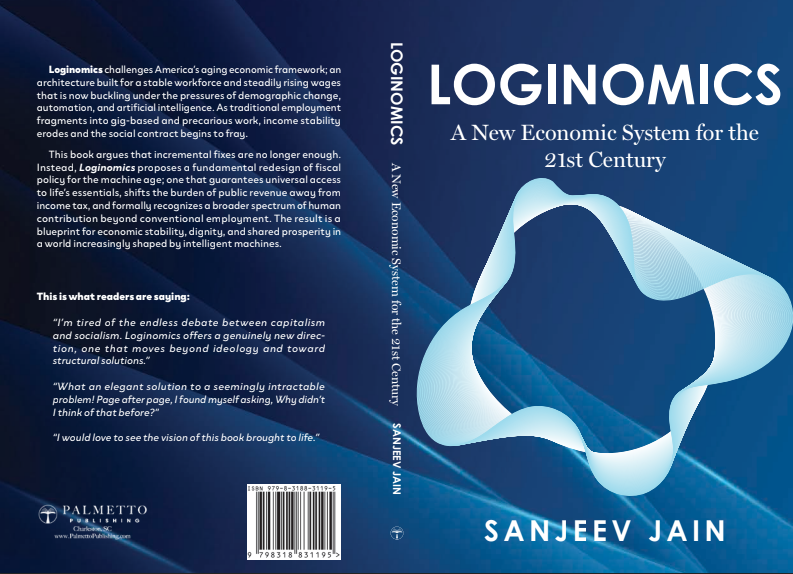
How to Build an Economy for People, Not Just Machines
Preface: An Economy Designed for Humans in the Age of Automation
Chapter 1: America’s Fiscal Model Was Built for a Different Century
America's economic framework was designed for an era of stable employment and rising wages, a world that no longer exists. This chapter exposes the foundational mismatch between outdated fiscal structures and the demands of a modern, technology-driven economy.
Chapter 2: Why the Old Toolkit Fails
Tax adjustments, interest rate tweaks, and stimulus packages were built for problems of the past. This chapter explains why conventional economic tools consistently fall short when applied to today's structural challenges like automation, inequality, and workforce instability.
Chapter 3: Technology Has Upended the Job Market Before. But This Time Is Different
History has seen technology displace workers before, but intelligent machines operate at a scale and speed unlike anything prior. This chapter makes the case that AI-driven automation is not a temporary disruption; it is a permanent restructuring of how labor and value relate.
Chapter 4: The Illusion of Government Finance
Politicians routinely compare government budgets to household finances, but this analogy is fundamentally misleading. This chapter dismantles the myth of government "running out of money" and introduces a more accurate understanding of sovereign fiscal capacity.
Chapter 5: What Money Actually Is
Most people use money every day without understanding what it truly represents. This chapter breaks down the real nature of money, not as a finite resource to be hoarded, but as a tool of public purpose that governments can create and direct.
Chapter 6: The Federal Reserve and the Plumbing of Money
Behind every transaction lies a complex system of institutions, accounts, and mechanisms most citizens never see. This chapter pulls back the curtain on how the Federal Reserve operates and how money actually flows through the modern economy.
Chapter 7: Government Spending and Money Creation
Government spending is not simply the redistribution of collected taxes; it is an act of money creation. This chapter explores how public expenditure shapes the money supply and why understanding this changes everything about fiscal policy debates.
Chapter 8: The Mission of the Federal Reserve Under Loginomics
Under the Loginomics framework, the Federal Reserve takes on a redefined and more purposeful role. This chapter outlines how monetary policy must evolve to support guaranteed essentials, human contribution, and a post-employment economy.
Chapter 9: The Dollar Cycle and the 15 Percent Rule
Loginomics introduces the 15 Percent Rule as a practical mechanism for aligning public revenue with real economic output. This chapter explains how the dollar cycle works and how this rule creates a more stable and equitable foundation for national finance.
Chapter 10: Dual Treasury Accounts—Essentials and Discretionary Spending
A single government budget treats housing, healthcare, and defense as competing priorities. This chapter proposes a dual-account treasury system that separates essential human needs from discretionary spending, ensuring that basic access is never held hostage to political negotiation.